
Steam vs. Evaporation – The Essential Difference
In known heat engine processes (steam power process, ORC process, Stirling process, Kalina process, …), the working medium (gas, steam) passes through the heat engine without changing its state of aggregation.
In contrast, the conversion of thermal energy in the TLC process is based on steam generation through flash evaporation of the hot working medium within the heat engine. This results in a temporal and spatial coexistence of steam and liquid in changing proportions.
For context:
In turbines and engines for steam power or ORC processes, a maximum liquid content of 5-10% in the steam is tolerated. Higher proportions pose a risk of surface damage due to droplet erosion.
Since the working medium in the TLC process is 100% liquid at the beginning of flash evaporation, there is an additional risk of surface damage due to cavitation.
Flash Evaporation in Detail
In the TLC process, the warm, completely liquid working medium is under high pressure at the beginning of flash evaporation, which prevents boiling and thus evaporation.
Only a reduction of this pressure to values below the current boiling pressure initiates the flash evaporation process.
Due to the decreasing pressure
– the warm, liquid working medium falls below its boiling limit
– the working medium begins to boil and steam forms
– the newly formed steam increases the volume (under the current pressure)
– this reduces the temperature of the remaining liquid part of the working medium by extracting heat of vaporization
Already existing steam continues to expand (with cooling) due to the decreasing pressure, further increasing the volume.
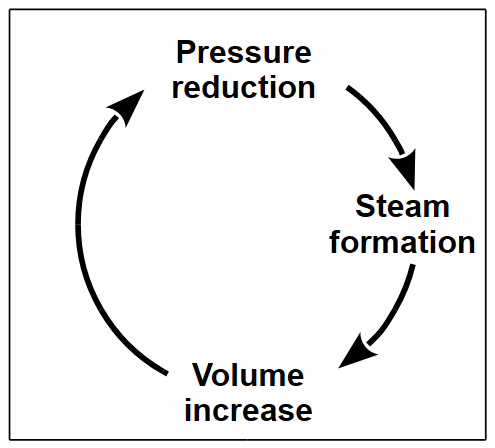
This cycle, starting with a reduction of the current pressure, steam formation, and volume increase, repeats continuously and only ends when the minimum temperature, the condensation temperature, determined by the temperature of the external heat sink, is reached.
The volume increase, under the respective current, decreasing pressure, corresponds to the converted thermal energy, which must be absorbed by the heat engine and converted into a mechanical motion (e.g., rotation).
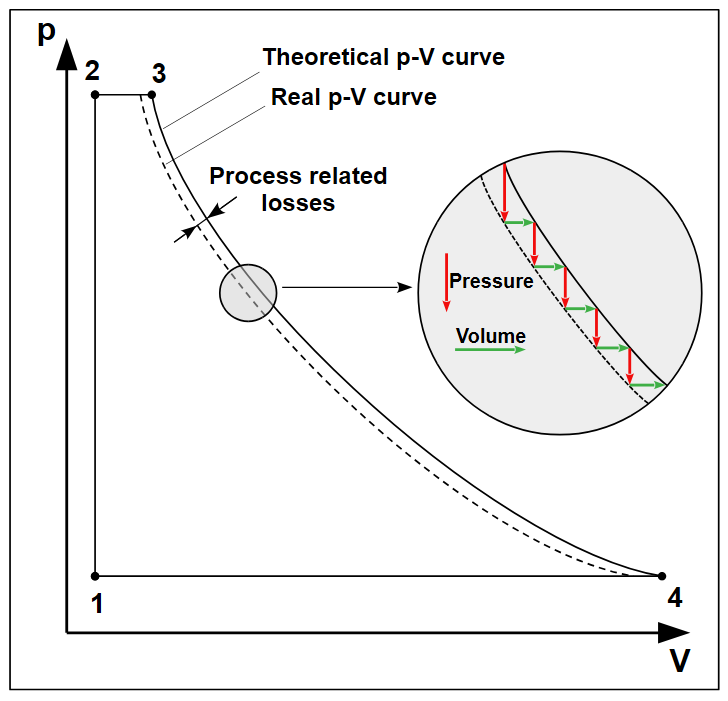
Boiling delay
A little-noticed detail of flash vaporization is what is known as boiling delay – a small time delay between the reduction in pressure and the onset of boiling.
This time delay results in a shift between the theoretical and actual p-V characteristic curves (see figure), which leads to process-related losses.
A Rarely Considered Parameter: Time
In known heat engine processes (ORC, Stirling, Kalina), where there is only a pressure reduction of the gaseous or vaporous working medium, the time required for pressure reduction is a subordinate parameter of the flow velocity.
This is different in the TLC process.
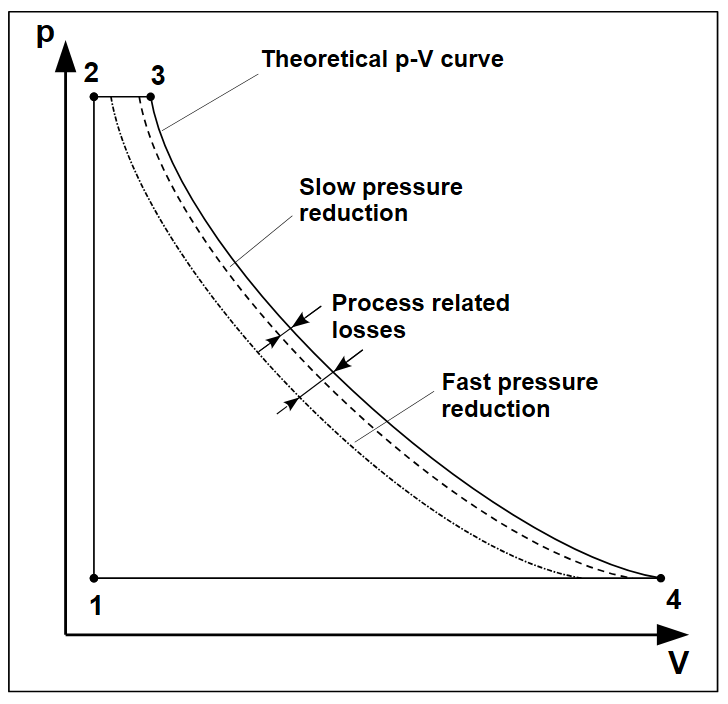
Due to the boiling delay, flash evaporation – the continuous formation of new vapor bubbles as the pressure steadily decreases, becomes a process with a time component.
A rapid decrease in pressure, or a decrease in pressure in too large steps, leads to higher conversion losses and thus a reduction in the thermodynamic efficiency of the heat engine (see figure).
In other words, for the conversion of the the absorbed thermal energy into mechanical energy the temporal progression of the flash evaporation is an important parameter.
Only in this way is it possible to maximize the amount of thermal energy converted through flash evaporation.
To achieve high thermodynamic efficiency, the goal is a slow, steady decrease in pressure.
The Perfect TLC Heat Engine – an All-Rounder
From a technical perspective, a TLC heat engine must simultaneously:
– continuously reduce the operating pressure to initiate the continuous flash evaporation of the warm working medium
– slow reduction of the operating pressure to achieve a high thermodynamic effiency
– continuously increase the volume of the working space for the newly generated working medium steam or the expansion of the already existing working medium steam
– convert the expansion work performed by the volume increase into mechanical energy (= motion)
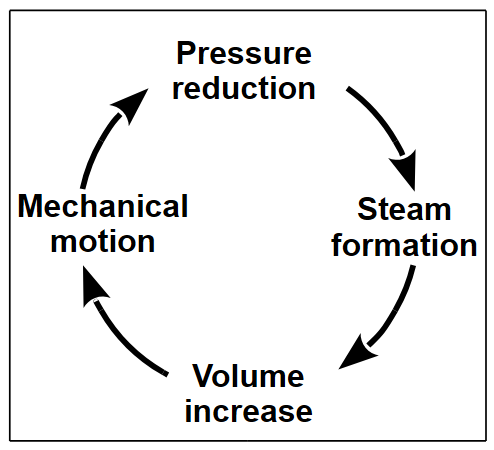
This cycle occurs with
– simultaneous coexistence of liquid and vaporous working medium
– starting with 100% liquid at the beginning of flash evaporation
– high pressure differences to be reduced of up to 40 bar
– large volume increase up to 300 times the original liquid volume
Summary
The TLC process places high demands on a suitable heat engine.
In addition to process-related parameters such as the continuous and slow reduction of operating pressure, the coexistence of liquid and steam, and the large volumetric expansion ratio, there are technical challenges such as avoiding droplet erosion and cavitation.
An analysis of the aforementioned requirements and problems led to the realization that for energy generation according to the TLC process, novel heat engines are required which, similar to engines for the Stirling process, are adapted to the specific requirements of flash evaporation.