
Efficiency
An outsider might ask, “Why use the TLC process when established thermodynamic processes for low temperatures, such as the ORC and Kalina processes, are already available?”
A comparison of the TLC process with the widely known and utilized Organic Rankine Cycle (ORC process), based purely on efficiency, yields the following picture.

The ORC process (upper curve family) reaches higher efficiency across all temperature ranges, thus appearing clearly superior to the TLC process (lower curve family).
However, this is a misconception, as the following comparison demonstrates.
Power Plant Structure
Comparing the structure of an ORC power plant with that of a TLC power plant shows only minor differences.
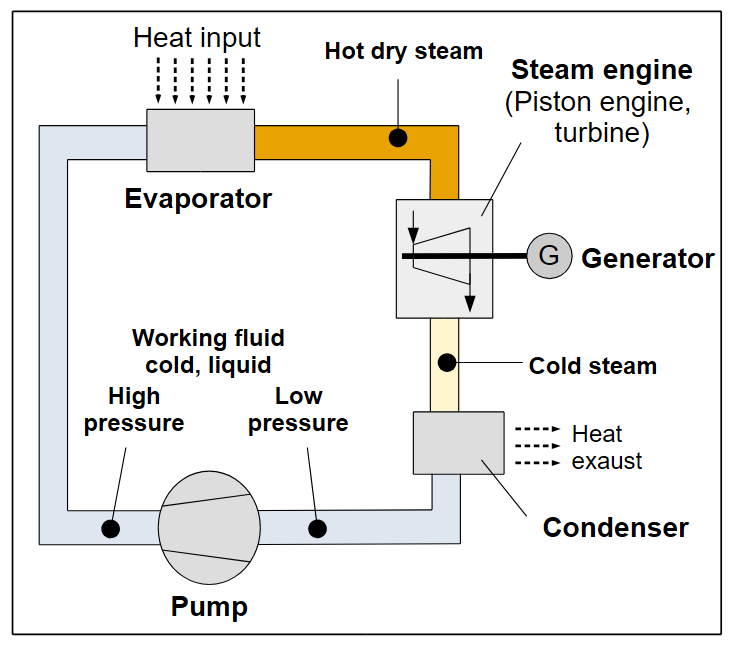
ORC Power Plant Structure
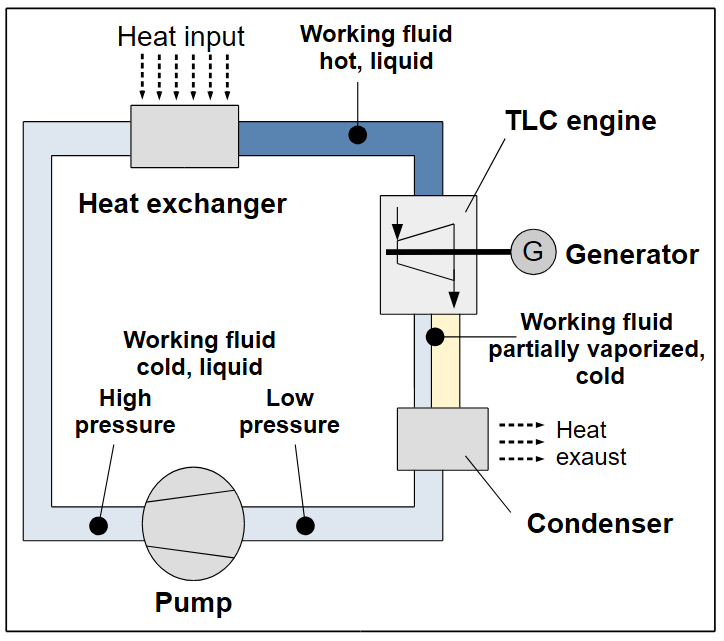
TLC Power Plant Structure
The ORC power plant operates with hot dry steam, while the TLC power plant uses a hot liquid working fluid.
This might seem like a minor distinction.
However, this small difference is precisely why the TLC process can generate significantly more electrical energy than the ORC process.
Detailed Process Analysis
The detailed differences become apparent when considering an internal and external process perspective. The internal process view focuses on the thermodynamics of the process, while the external process view considers the cooling of the heat source.
From the internal process view of the ORC process, it becomes clear that the portion of thermal energy required for evaporating the working fluid is cooled from a higher temperature to the evaporation temperature, thereby being thermally devalued. This leads to so-called exergy losses.
Further losses in the ORC process occur during heating.
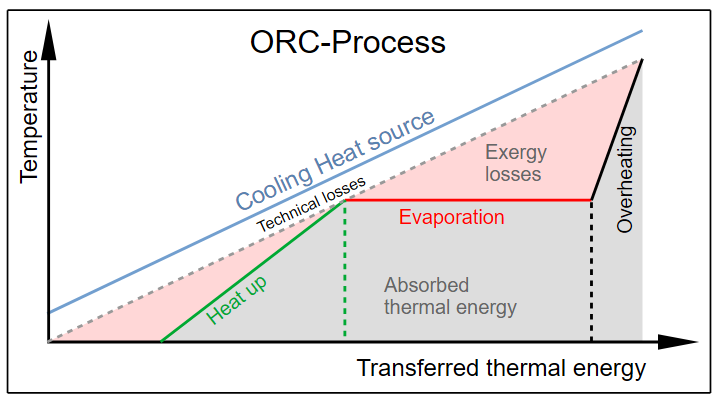
Internal Process View
External Process View
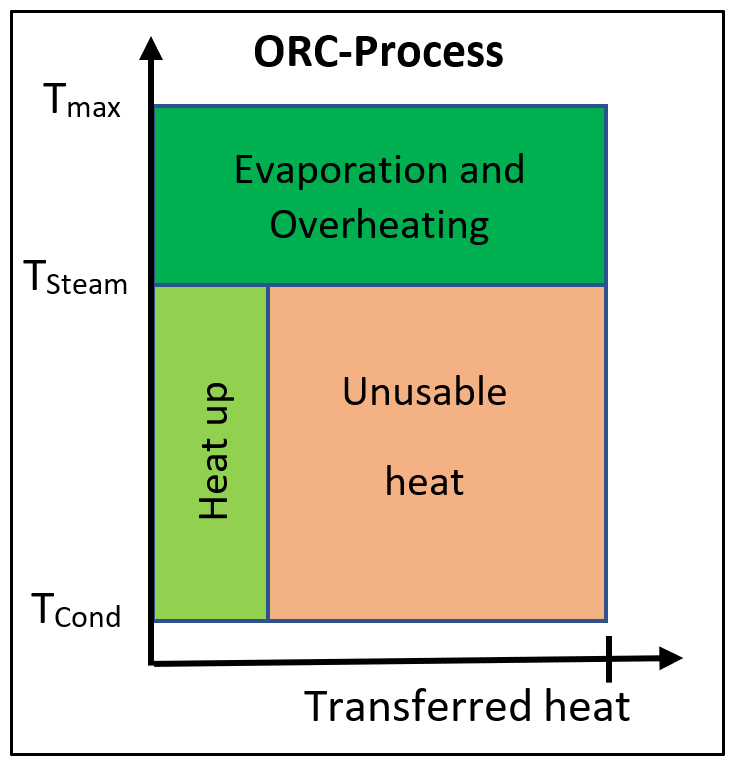
The reason for this becomes clear from the external process view:
The pressurized liquid working fluid is first heated from the condensation temperature TCond to the evaporation temperature TSteam.
In the second step, the working fluid is evaporated and superheated.
However, only thermal energy with a temperature above the evaporation temperature can be used for evaporation and superheating. For evaporation, several times the amount of thermal energy is required per kilogram of working fluid compared to what is needed for heating the liquid working fluid per kilogram.
A large portion of thermal energy below the evaporation temperature remains unused.
This means that in the ORC process, losses occur in two areas:
1. – Exergetic losses due to “cooling down” the external thermal energy from a higher temperature to the lower evaporation temperature
2. – Incomplete absorption of thermal energy below the evaporation temperature
In contrast, the TLC process only involves heating the liquid, pressurized working fluid without evaporation. Therefore, the working fluid can absorb the entire thermal energy from the condensation temperature TCond up to TMax.
This is shown in both the internal and external process view.
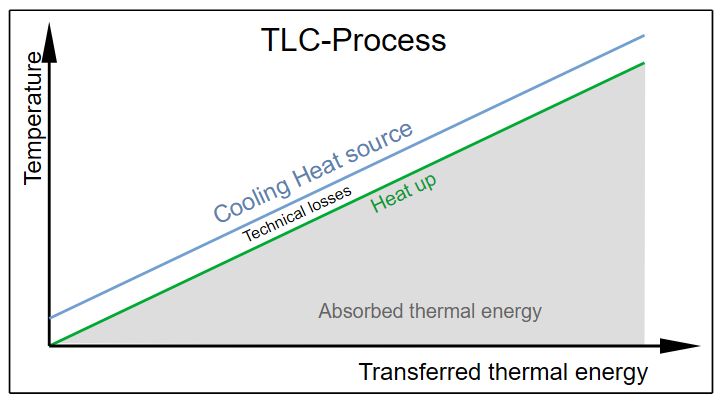
Internal Process View
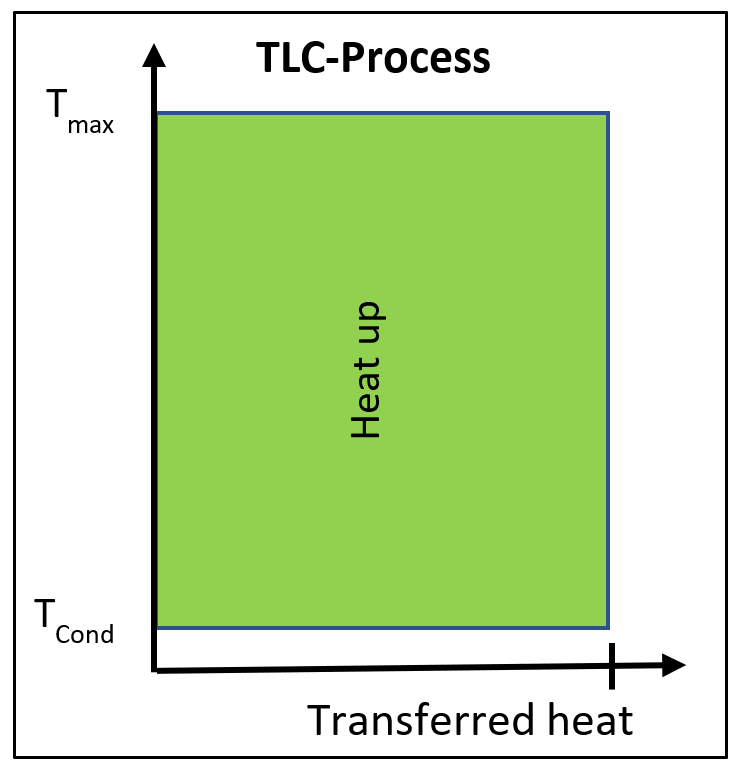
External Process View
Calculations
The significance of the differences in heat absorption, and thus the losses in the ORC process, can also be mathematically shown.
The following two scenarios were chosen for a direct process comparison:
The heat from 100 m³ of flue gas (e.g., engine exhaust) with a maximum temperature TMax of 300°C or TMax of 200°C is to be converted into mechanical energy in an ORC or TLC process.
Simple alcohol (ethanol) will be used as the working fluid in both processes.
The condensation of the resulting alcohol vapor occurs at a condensation temperature TCond of 50°C.
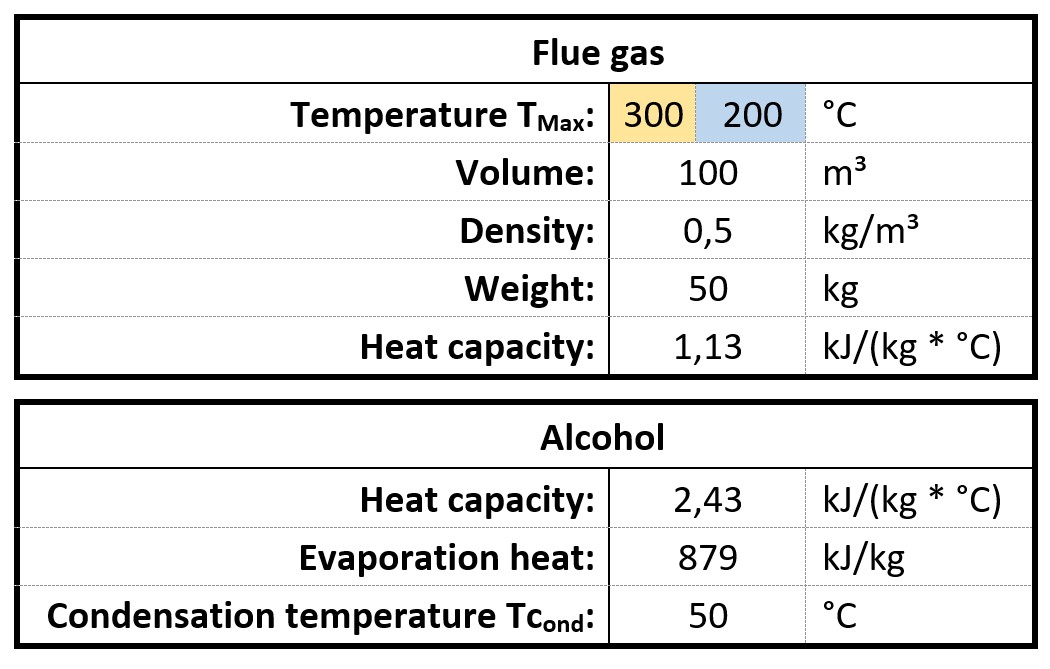
To compare both processes, the amount of heat absorbed before the conversion of thermal energy into mechanical and subsequently electrical energy is first calculated. For the ORC process, various evaporation temperatures are also considered to illustrate the influence of the evaporation temperature.
To facilitate understanding of the calculations, the formulas used are provided in the first column.
The calculations are based on the assumption of a completely lossless (unrealistic) conversion process.
Calculation with TMax = 300°C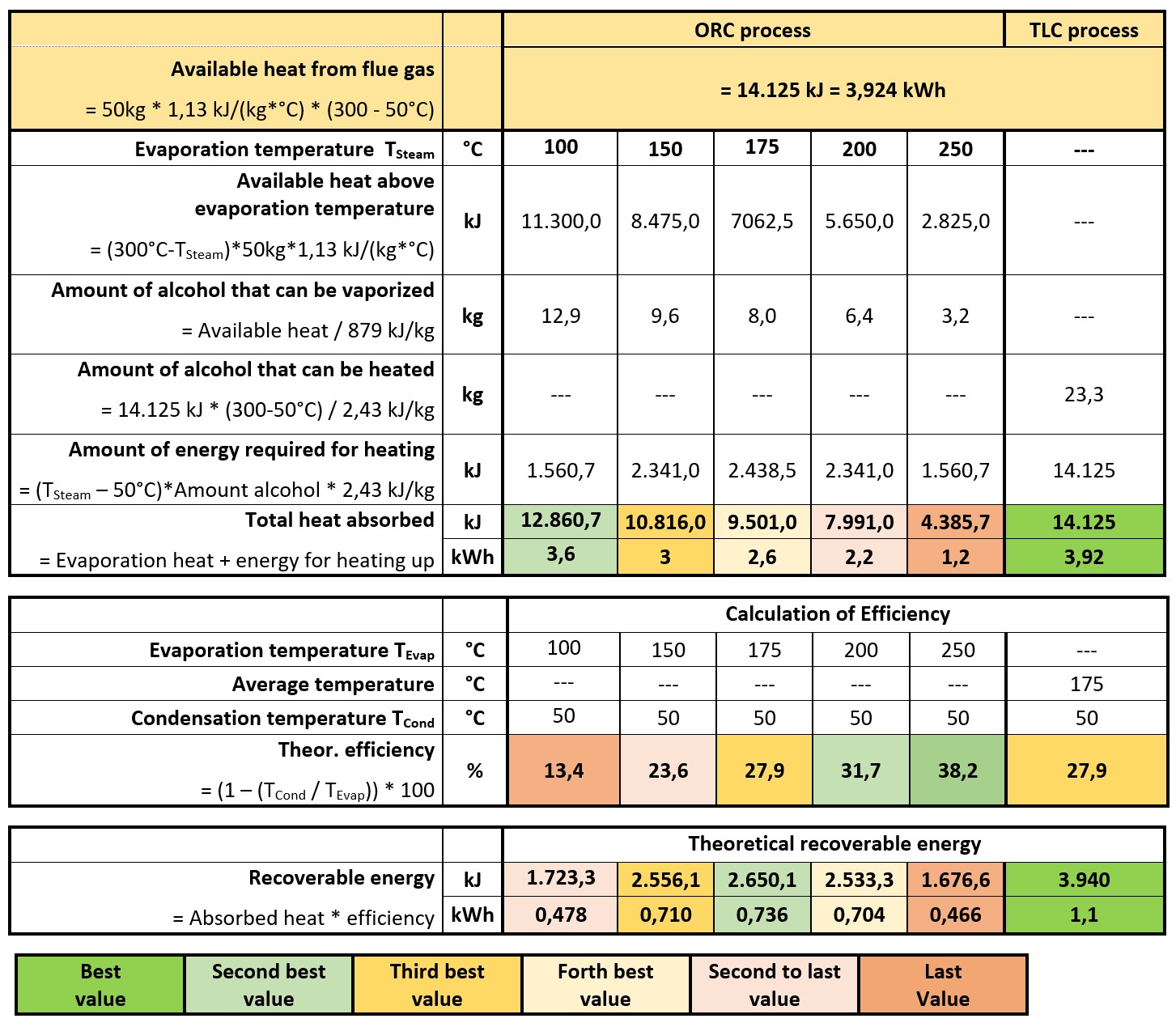
Calculation with TMax = 200°C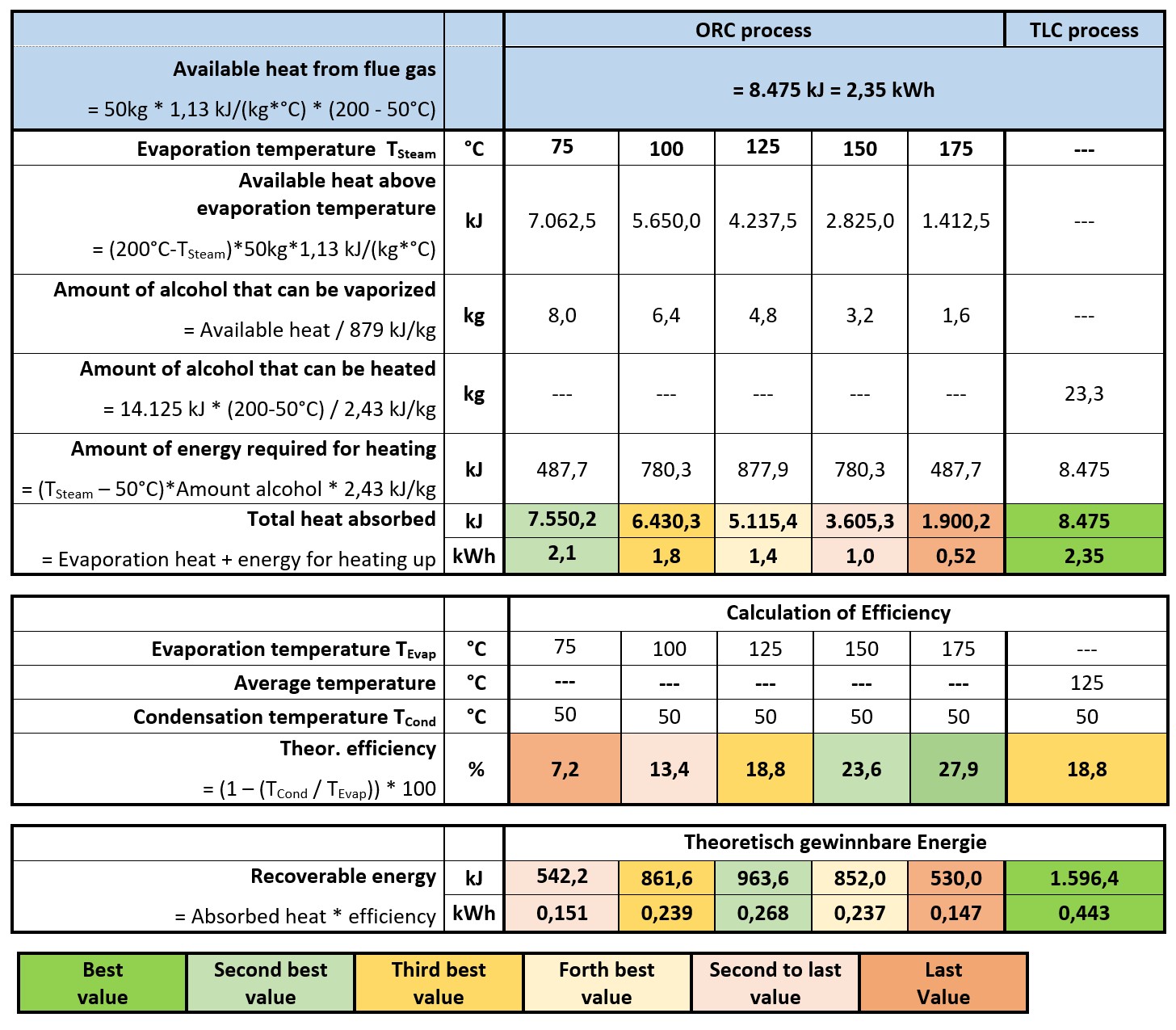
Conclusion
Because the liquid working fluid in the TLC process is only heated:
1. – no “devaluation” of thermal energy occurs through evaporation as in the ORC process
2. – more thermal energy is absorbed by the working fluid at higher temperatures
3. – with the TLC process, at TMax = 300°C, ~50% more energy is converted than with the ORC process
4. – the lower the maximum temperature, the greater the advantage of the TLC process (~66% more converted energy at TMax = 200°C)
The larger amount of absorbed thermal energy at higher temperatures allows the TLC process, despite only moderate efficiency, to theoretically generate more electrical energy than the ORC process with higher efficiencies.
How much of the absorbed thermal energy is actually converted into electrical energy is determined by the technical efficiency of the heat engine and generator used.