
Those familiar with energy generation from low-temperature heat and the ORC process may ask themselves why water is used as the working fluid rather than other substances that boil at lower temperatures, such as pentane.
The short answer
The TLC process makes it possible, and the TLC rotor can operate with any working fluid.
The detailed answer
To answer this question, one must delve deeper into thermodynamics and rephrase the question: Why are working fluids that boil at lower temperatures advantageous for the ORC process?
The reason lies in the shape of the so-called saturated vapor curve (see figures, right side of the dashed line).
Depending on the shape of the saturated vapor curve, a distinction is made between so-called “wet,” “isentropic,” or “dry” working fluids.
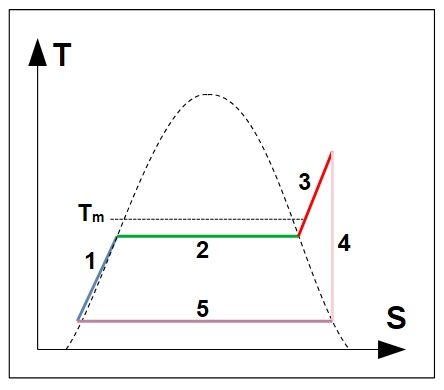
Wet working fluids
(e.g., water)
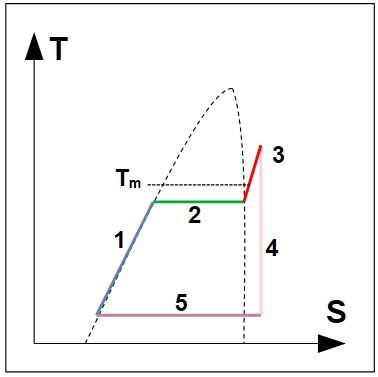
Isentropic working fluids
(e.g., CFCs such as R11, R12)
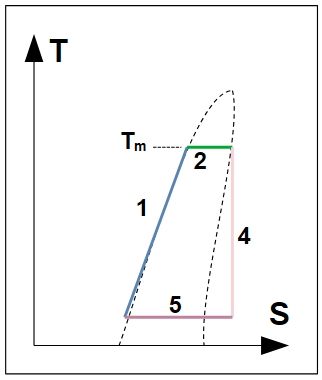
Dry working fluids
(e.g., n-pentane)
Line 1 – Heating of the liquid working fluid
Line 2 – Evaporation of the working fluid
Line 3 – Superheating of the working fluid
Line 4 – Work performed by the vapor
Line 5 – Condensation of the working fluid vapor
The use of “wet” working fluids in the ORC process requires greater superheating of the vapor to prevent premature condensation—i.e., a higher proportion of liquid in the vapor—at the end of vapor expansion (transition from Line 4 to 5) as it flows through the heat engine (turbine, steam engine). This would cause damage to the heat engine.
However, the required superheating of the vapor reduces the mean temperature Tm, which leads to a deterioration in Carnot efficiency and thus less energy generated.
“Isentropic” working fluids require only minimal superheating, while “dry” working fluids sometimes require no superheating at all, resulting in a higher mean temperature Tm and thus better efficiency and more energy generated.
Hence the preferred use of “dry” working fluids in ORC heat power plants.
The TLC process is based on the use of a hot, liquid working fluid that is only partially vaporized within the heat engine. The operating principle of the TLC rotor as a heat engine requires that both liquid and vapor of the working medium be present simultaneously.
Both requirements can be met by “isentropic” as well as “dry” working fluids.
However, the use of “isentropic” and “dry” working fluids results in both technical and economic disadvantages, such as:
– Risk of fire and explosion as well as environmental damage in case of media leakage
– Resulting increased safety requirements for the design
– Regular safety inspections of the entire heat power plant are required
A direct process comparison reveals further disadvantages.
For a low-temperature heat power plant with a maximum inlet temperature of 120°C, a condensation temperature of 50°C, and an output of 50 kW, the following (theoretical) operating parameters result (see table):
| Water (wet working fluid) | Benzene (isentropic working fluid) | n-Pentane (dry working fluid) | |
| Working fluid flow rate required | 110.3 l/min | 296.9 l/min | 325.3 l/min |
| Pump differential pressure | 2.0 bar | 2.8 bar | 7.6 bar |
| Required pump power | 0.5 kW | 1.8 kW | 5.5 kW |
| Maximum operating pressure | 2.1 bar (a) | 3.1 bar (a) | 9.2 bar (a) |
This means that to achieve the same output with working fluids other than water, approximately three times the amount of working fluid is required, in some cases at significantly higher pressures.
The larger working fluid quantity and higher differential pressure require feed pumps with correspondingly higher power, which reduces the deliverable output of the heat power plant.
Additionally, larger pipe cross-sections and a design for higher operating pressures are required. Both factors increase manufacturing costs.
Water is therefore the ideal working fluid for a heat power plant with a TLC rotor.